Cynefin
Welsh Word Series 3 | Cynefin | Habitat or sense of belonging to a place, particularly in nature
As I look out of my little summerhouse office window I see the shock of bright yellow forsythia spreading along the wooden mildewed fence. It is waving in the cold March breeze. The bare feathery branches of the silver birch tree dance in response in the top right corner of my window view. As I look out, my eyes squint against the sun, which blurs the details. There is a backdrop of the redbrick houses of my neighbours and underneath the birdsong is the constant hum of traffic which ebbs and flows along the busy village B road I live on. I belong in this book-lined, wood-panelled space.
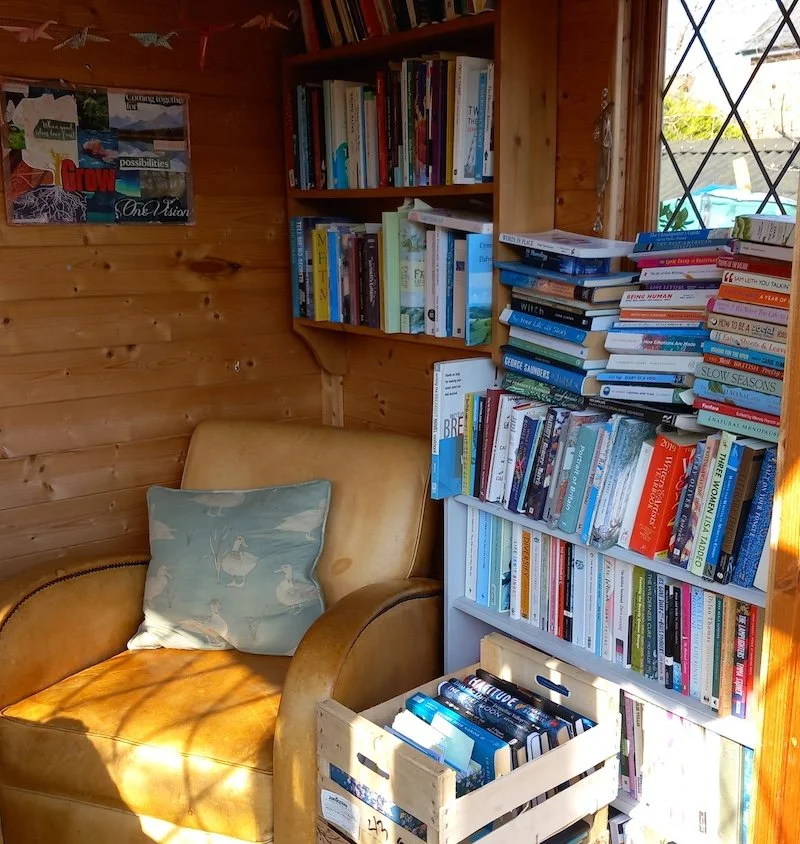
Mel’s summerhouse office
Opposite this chair is my desk. There is no room for anything else. I’d invite you in for a cuppa but our knees might bang as it’s a bit of a squash for two. And anyway, this is my space. I am so very fortunate to have this room of my own. This is my habitat. I belong here. This is where in spring, I watch the dandelions, cleavers, nettles search for space amongst the self-seeding pink geraniums and the fennel, bay, lemon balm, thyme rosemary and oregano which I’ve planted.
In her book, If Women Rose Rooted: A Life-Changing Journey To Authenticity and Belonging
says this:
Once, we were native to our own places; once, we belonged. There is a Gaelic word for it, and like so many Gaelic words, coming from a language which rises out of a deeply connected animistic worldview, it is not easily translatable into English. These are the languages of root and leaf, of field and stone, of seaweed and salt. These are the words whispered in our ears by the land as if by a lover; the languages which tell us that we and the land are one. In Irish, the word is dúchas; in Scottish Gaelic, dùthchas. It expresses a sense of belonging to place, to a certain area of land; it expresses a sense of rootedness, by ancient lineage and ancestry, in the community which has responsibility for that place. In Welsh, the word cynefin has a similar meaning. This is the way our ancestors lived. (p. 355)
The word I’ve chosen for this week’s creative writing workshops, cynefin*, (pronounced: kuh-nev-in) is an old Welsh word that was used in the past to describe the way that sheep territorialise their own piece of land to graze. It can also describe the habitual tracks and trails worn by animals in hillsides. For Welsh hill farmers cynefin is a feeling and ‘you can have cynefin for more than one place’. It is not only a connection with the land but also a sense of responsibility to it and belonging to it (Adams, 2023**). This connects with Robin Wall Kimmerer’s exploration of reciprocity and language, a feeling of being enmeshed with the land.
I have described my writing room, but it is my warm, dry, safe, thinking, working space created in the tiny piece of land that I am observer of, that I am a guardian of and that I have a reciprocal relationship with - my garden.
Writing invitation
This week’s invitation is one that explores the inter-connectedness of things, but it is also a fun beginning to a writing session.
Draw four concentric circles.
Write habitat, cynefin, or belonging in the middle circle.
Think of, imagine or visualise what you would like in your ideal habitat or place where you belong (you can also do this for a fictional character).
Circle 2: Write what conditions you would like in your habitat or place - these would be external such as lighting, weather, sensory (what snacks or smells you’d like there). And also elemental (type of water, fire, air or rock).
Circle 3: Write which objects you’d like there. Sentimental, precious to you, or from nature.
Circle 4: Any living beings…plants, animals, humans. You can also add beings you don’t want in this space.
Then beginning in the centre with your word, draw lines outwards making random or intuitive connections through the circles.
Pick one line to freewrite from.
_____________________________________________________________________
This blog post was created by Mel Parks, a writer, researcher and workshop facilitator based in Sussex, UK. Mel runs writing workshops locally and on Zoom and researches creativity in midlife as well as her personal connection to nature. She has been widely published and is currently working on a series of moon and plant-inspired essays.
It is free to read and share, but if you value my work, please do stop by my virtual honesty box and leave a handful of loose change.
This newsletter may contain affiliate links.
*The Welsh Government has chosen cynefin, as part of the Curriculum for Wales and has defined it as ‘the place where we feel we belong, where the people and landscape around us are familiar’.
**Adams, D. Cynefin – Being of place. An investigation into the perspectives of first-language Welsh speaking hill farmers into the meaning of the word cynefin and the significance for education in Wales and beyond. Journal of Outdoor and Environmental Education (2023). https://doi.org/10.1007/s42322-023-00144-2